概述
动静脉畸形 (AVM) 血流
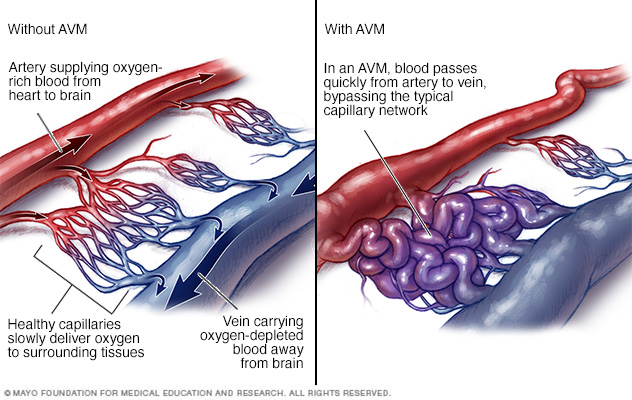
动静脉畸形 (AVM) 血流
动静脉畸形(AVM)导致血液从动脉迅速流到静脉,破坏了正常的血液流动并夺走了周围组织的氧气。
动静脉畸形(AVM)是指连接动脉和静脉的血管出现异常缠结,这会扰乱血液流动和氧循环。动脉负责将富氧血液从心脏输送到大脑和其他器官。静脉将贫氧血液送回心肺。
如果 AVM 妨碍这一关键过程,周围组织可能无法获得足够供氧。而且,由于 AVM 中的缠结血管并非正常形成,可能弱化和破裂。如果 AVM 处于脑中并破裂,可能引起大脑出血、卒中或脑损伤。大脑中出血也称为脑出血。
了解更多关于脑 AVM(动静脉畸形)的信息。
AVM 的病因尚不清楚。极少数情况下,它们为遗传性,即在家族中遗传。
确诊后,脑 AVM 通常可以成功治愈,防止或减少并发症风险。
症状
AVM 的症状因病变位置而异。通常,初期症状在出血后出现。除了出血之外,症状还可能包括:
- 神经功能逐渐丧失
- 头痛
- 恶心和呕吐
- 癫痫发作
- 失去意识
其他可能的症状包括:
- 肌肉无力
- 身体的某个部位发生瘫痪
- 失去协调能力,可能导致步态问题
- 难以执行需要计划的任务
- 下肢无力
- 背痛
- 头晕
- 视力问题,包括丧失部分视野、丧失对眼球运动的控制或部分视神经肿胀
- 说话或理解语言困难
- 异常感觉,包括麻木感、刺痛或突然疼痛
- 记忆丧失或痴呆症
- 幻觉
- 意识模糊
儿童和青少年可能会有学习或行为问题。
一种被称为盖伦静脉缺损的 AVM,能导致人出生时或出生后不久就出现症状。盖伦静脉缺损位于大脑深处。症状可能包括:
- 脑中液体聚积,导致头围变大
- 头皮静脉肿胀
- 癫痫发作
- 发育停滞
- 充血性心力衰竭
何时就诊
如果出现 AVM 的任何症状,例如头痛、头晕、视力问题、癫痫发作以及思考或神经功能改变,请就医。很多 AVM 都是在检查其他疾病期间意外发现的,通常是在因与 AVM 没有直接关系的原因而进行 CT 扫描或 MRI 检查后。
病因
AVM 由动脉和静脉之间的直接连接不正常引起,但专家尚不清楚其中的原因。某些基因改变可能起到一定作用,但大多数类型通常不会遗传(即在家族中传给下一代)。
风险因素
极少数情况下,有动静脉畸形家族史可能会增加风险。但大多数类型的动静脉畸形不会遗传。
某些遗传状况可能会增加患动静脉畸形的风险,其中包括遗传性出血性毛细血管扩张症(Osler-Weber-Rendu 综合征)。
并发症
AVM 最常见的并发症是出血和癫痫发作。如果不予治疗,出血会引发严重的神经系统损伤,甚至可能危及生命。
April 21, 2023
- Arteriovenous malformation information page. National Institute of Neurological Disorders and Stroke. https://www.ninds.nih.gov/Disorders/All-Disorders/Arteriovenous-Malformation-Information-Page. Accessed Sept. 9, 2022.
- What is an arteriovenous malformation (AVM)? American Stroke Association. https://www.stroke.org/en/about-stroke/types-of-stroke/hemorrhagic-strokes-bleeds/what-is-an-arteriovenous-malformation. Accessed Sept. 9, 2022.
- Singer RJ, et al. Brain arteriovenous malformations. https://www.uptodate.com/contents/search. Accessed Sept. 9, 2022.
- Chen CJ, et al. Brain arteriovenous malformations: A review of natural history, pathobiology, and interventions. Neurology. 2020; doi:10.1212/WNL.0000000000010968.
- Arteriovenous malformations and other vascular lesions of the central nervous system fact sheet. National Institute of Neurological Disorders and Stroke. https://www.ninds.nih.gov/Disorders/Patient-Caregiver-Education/Fact-Sheets/Arteriovenous-Malformation-Fact-Sheet. Accessed Sept. 9, 2022.
- Singer RJ, et al. Vascular malformations of the central nervous system. https://www.uptodate.com/contents/search. Accessed Sept. 9, 2022.
- Grotta JC, et al., eds. Surgical management of cranial and spinal arteriovenous malformations. In: Stroke: Pathophysiology, Diagnosis, and Management. 7th ed. Elsevier; 2021. https://www.clinicalkey.com. Accessed Sept. 9, 2022.
- Winn RH, ed. Surgical and radiosurgical management of grade IV and V arteriovenous malformations. In: Youmans and Winn Neurological Surgery. 8th ed. Elsevier; 2023. https://www.clinicalkey.com. Accessed Sept. 9, 2022.
- Arteriovenous malformations. American Association of Neurological Surgeons. https://www.aans.org/Patients/Neurosurgical-Conditions-and-Treatments/Arteriovenous-Malformations. Accessed Sept. 17, 2022.
- AskMayoExpert. Cerebral vascular malformations. Mayo Clinic; 2021.
- Ami TR. Allscripts EPSi. Mayo Clinic. July 13, 2022.